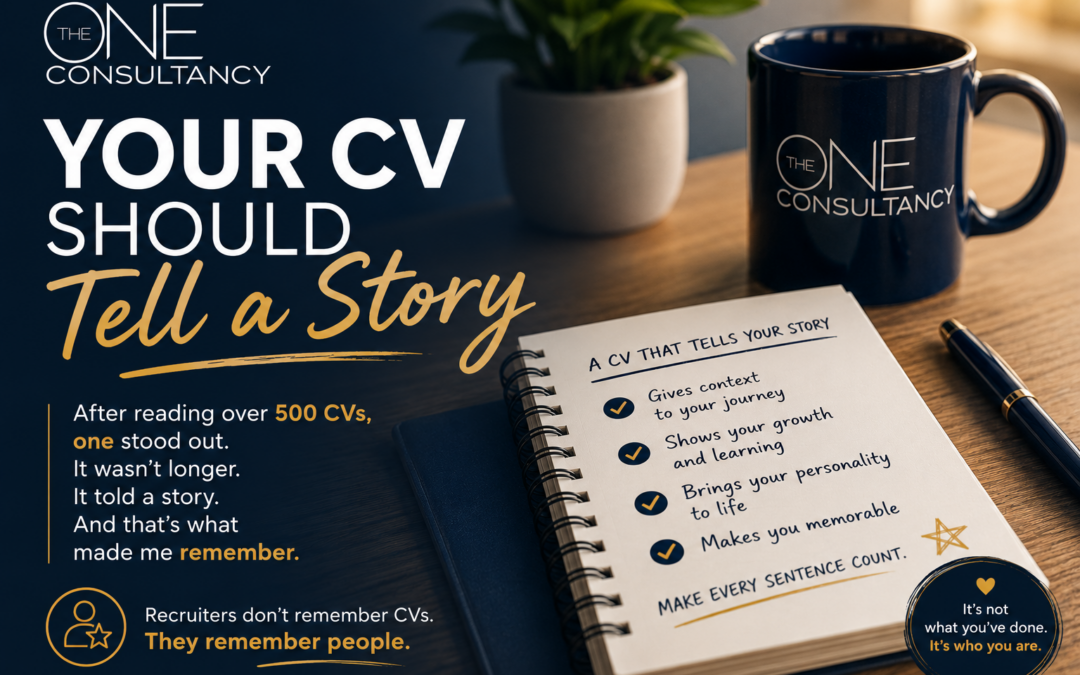
Over the past few weeks, I’ve been recruiting on behalf of a client, and in that time, I’ve reviewed more than 500 CVs.
It’s been an interesting experience because, despite everyone being different, so many CVs end up looking exactly the same. The qualifications are often similar, the job histories follow a familiar pattern, and the language is almost identical. After reading hundreds of applications, they all begin to merge into one. Now there are a number that have made it through to the next stage, but one CV landed in my inbox that really made me stop scrolling.
The candidate has also now progressed to the first stage, which is a telephone interview. Whether she gets through to the next stage, I genuinely don’t know yet. I will have an answer at the end of the week. Regardless of what happens next, her CV had already done exactly what it needed to do, it stood out.
At first glance, there was nothing dramatically different about it. It wasn’t full of fancy graphics, colourful designs or pages of achievements. In fact, there were applicants with stronger qualifications and more experience on paper.
So why did I remember hers? Because she told me her story.
Instead of simply listing previous jobs and responsibilities, she explained her journey. She shared why she made certain career decisions, what she learnt from each role and how those experiences had shaped her. By the time I’d finished reading, I felt like I knew the person behind the CV, not just the positions she’d held.
You might think that telling your story would make a CV much longer, it didn’t.
Her CV was pretty much the same length as the vast majority of the other 500 I’d read. It certainly wasn’t three or four pages long. In fact, for most people, a CV should be no more than two pages. The difference wasn’t the amount she’d written; it was how she’d used the space.
While many candidates filled their CVs with generic responsibilities and overused buzzwords, she used one and half pages to tell me something about herself. Every paragraph had a purpose. Every sentence helped me understand who she was, what motivated her and how she’d grown throughout her career.
Was it perfect? No. There were a few errors that could easily be improved and could do with a little bit of polishing..
The story was stronger than the imperfections.
Recruiters, surprisingly spend, little time on the first review of a CV. Research often suggests it’s less than a minute. When you’ve read hundreds of applications, you’re not looking for someone who has copied the perfect template or used the most impressive corporate language.
You’re looking for someone you’ll remember. People often ask me how to make their CV stand out. Don’t just tell employers what you’ve done, tell them who you are. Your CV shouldn’t just be a list of jobs. It should explain your journey, your decisions, your growth and what makes you different from the hundreds of other people applying for the same role.
After reading more than a large number of CVs, I honestly can’t remember most of them. But I remember the one that told a story and that’s exactly why I decided to write this blog.
Because the purpose of a CV isn’t just to get read.
It’s to be remembered.
Mike Jack is Director of The One Consultancy